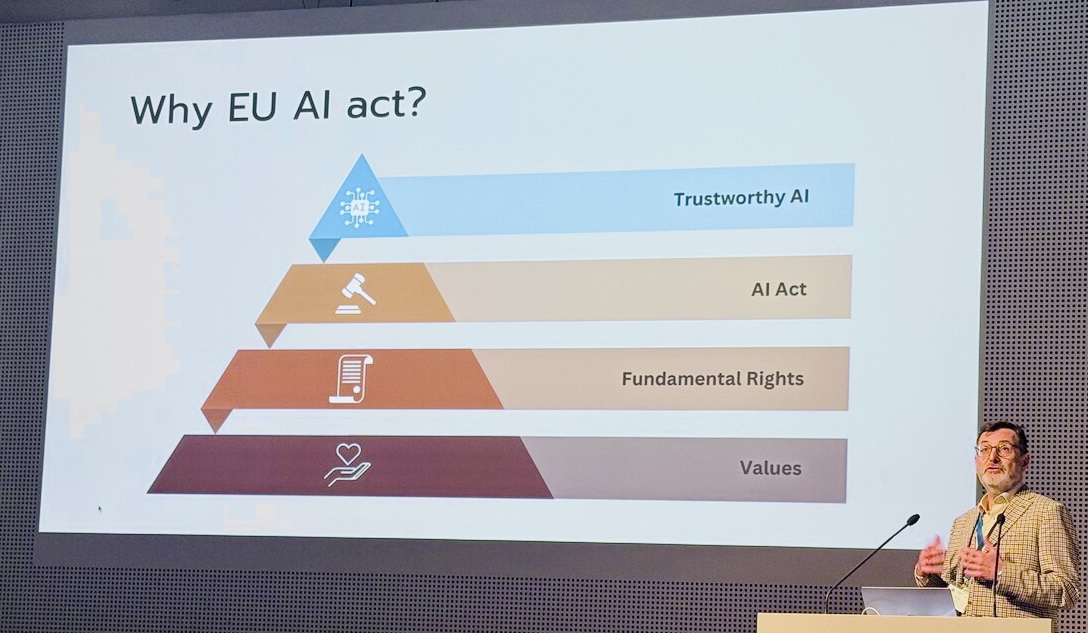

Yesterday, at the Indian Supercomputing Conference, I had the opportunity to meet leaders shaping the future of AI, digital transformation, and national innovation strategies.
A recurring theme across conversations was the emergence of India’s new AI Governance Principles – including the 7 AI Sutras or Principles.
These principles signal a strong national commitment to trustworthy, human-centered, and innovation-friendly AI. But as every practitioner knows: principles alone don’t operationalize themselves.
This is where Value-based Engineering (VBE) offers a practical, standards-aligned approach to help organizations move from high-level intentions to structured implementation.
Trust is the Foundation – but trust must be earned and built through engineer
India’s first Sutra states: “Trust is the Foundation.” The declaration alone cannot create trust. It emerges when the remaining Sutras are handled systematically – through clear processes, transparent decision-making, and traceable documentation.
VBE supports organizations in developing these foundations, enabling them to align their AI systems with India’s governance ambitions.
How VBE supports the 7 AI Sutras
Sutra 2: People First – understanding stakeholder concerns, including nature
A “People First” approach requires more than human oversight. It demands a deep understanding of stakeholder expectations, worries, and lived realities.
VBE starts exactly here: identifying stakeholders, exploring their values and concerns, and making impacts explicit — both positive and negative.
Importantly, nature is also considered an indirect stakeholder. This resonates with Sutra 7 on sustainability and enables environmental concerns to be treated as legitimate design inputs.
Sutra 3: Innovation over Restraint – balancing risks and value creation
India encourages responsible innovation instead of risk-averse paralysis.
VBE supports this by highlighting not only risks but also value advantages and opportunities that a system can bring. This balanced view helps organizations innovate confidently while staying aligned with societal expectations.
Sutra 4–6: Fairness, Accountability & Explainability – enabled through structure and traceability
Fairness, equity, accountability, and understandability do not happen organically. They require process discipline.
VBE provides a clear workflow, structured templates, and full traceability from values to risks to system requirements. It also enables audit-ready documentation for governance and compliance.
Standards such as IEEE 7003 (Algorithmic Bias Considerations) can be embedded into VBE’s backbone process, ensuring that specialized guidance integrates smoothly into a unified lifecycle.
Sutra 7: Safety, Resilience & Sustainability – required minimum standards vs. trust
Safety regulations in domains such as medicine, automotive, and infrastructure define the minimum acceptable threshold for system approval and will always be important safety and security tools.
VBE does not replace domain-specific safety engineering. Instead, it adds what safety alone cannot achieve: transparency, ethical reasoning, stakeholder perspectives, sustainability considerations, and clear documentation.
Trust requires more than meeting minimum standards. It requires a documented process that explains why decisions were made and how risks and responsibilities were handled. VBE delivers exactly this.
A growing, open ecosystem grounded in international standards
VBE is an open, expanding ecosystem built on ISO/IEC/IEEE 24748-7000 and compatible with additional standards, such as IEEE 7003, that address bias concerns (see Sutra 4). It provides
- templates,
- guidance,
- practical experience from public-sector and industry use cases, and
- certification possibilities to show case trust and ensure a high qualit.
This makes it highly compatible with India’s governance vision — scalable, structured, and adaptable.
Conclusion
India’s 7 AI Sutras set the right direction: responsible innovation, human-centricity, fairness, transparency, sustainability, and — above all — trust.
But trust doesn’t emerge automatically. It must be designed, documented, and maintained throughout the AI system lifecycle.
Value-based Engineering provides the practical backbone to do exactly that.
As India accelerates its leadership in AI and digital transformation, VBE can help organizations operationalize these principles while strengthening public trust and enabling innovation.